By Dr. Fasloen Adam Senior Lecturer in the Division of Occupational Therapy, Stellenbosch University, South Africa
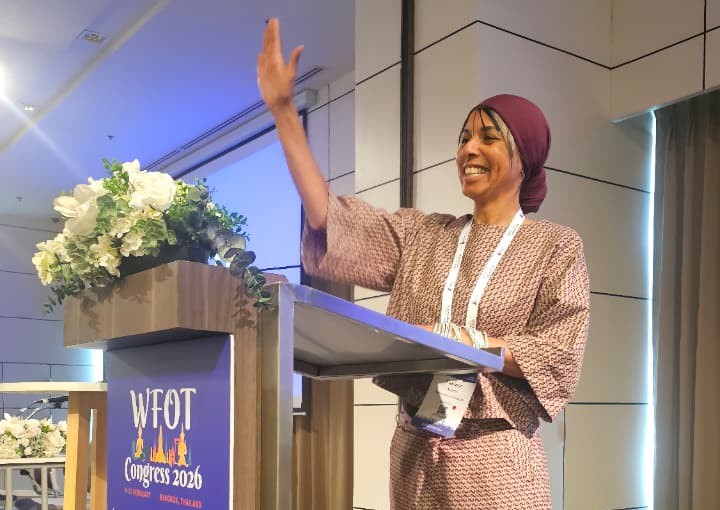
I had the privilege of attending the 19th World Federation of Occupational Therapists Congress, held from 9–12 February 2026 in Bangkok, Thailand. The Congress theme, “Inspiring Change, Innovating Futures,” invited us to explore new opportunities, tools, and ways of seeing and doing things, and it encouraged the sharing of diverse perspectives to move the profession forward. This overarching theme was examined through a series of subthemes, including:
- Equity and Inclusion — addressing occupational justice and access across contexts;
- Innovation in Practice — exploring new technologies, models, and approaches in OT;
- Education and Research — advancing curriculum, pedagogy, and evidence‑based practice;
- Global Collaboration — strengthening partnerships across regions and disciplines;
- Sustainability and Future Directions — embedding OT within broader social and environmental change.
Keynote addresses included:
Professor Elspeth Froude — The Power of Purpose
Professor Froude framed occupational therapy around supporting participation in meaningful occupations and urged the profession to close long-standing research-to-practice gaps, stressing the ethical and practical importance of translating evidence into everyday clinical work. One shocking fact she highlighted was that, on average, research takes 17 years to be implemented in practice. We should do better!
Dr Pisak Chinchai — Contextualising Practice
Dr Chinchai emphasised locally relevant practice and education, drawing on regional experience to argue for curricula and service models that respond to community needs rather than importing one‑size‑fits‑all solutions. He also stressed the importance of health promotion and prevention at the community level; within their health model, about 1.07 million village health workers serve a population of 71.5 million people.
On a personal level, I enjoyed meeting practitioners, educators, researchers, and students from across the globe to share knowledge, learn what others are doing, strengthen networks, share ideas and explore the profession’s future direction. The presentations I attended were inspiring, with advocacy, justice, and equity recurring as central themes. I was particularly proud of the size of the South African delegation and the range and calibre of presentations by my colleagues.
As with any conference of this size, there were highs and lows. As the congress was in Thailand, I would have appreciated a stronger presence of Thai or regional voices during the opening ceremony and the first keynote. I missed hearing the Thai perspective. Inclusion was also an issue, as Muslim dietary needs were not initially catered to. Many delegates reminded me that the 2018 WFOT in South Africa set a high bar for inclusion and vibrancy, which no one could match since. Lastly, there were presentations related to war and persons with mental disabilities, which, I feel, should not have been included in the programme due to ethical reasons.
Thailand itself was colourful, busy, vibrant, noisy, and steeped in culture. It felt welcoming, safe and public transport was more accessible and reliable.
I thoroughly enjoyed attending the Congress. I learned a great deal, met many colleagues from around the world, and was impressed, if occasionally overwhelmed, by the scope and scale of the event. Despite the intensity, the experience was well worth it. The conversations, connections, and new ideas have left me energised. I look forward to carrying this momentum into practice and education, and to reconnecting with the global OT community at the next WFOT Congress, where I hope we will have even a greater presence.